Thank you for contacting us.
We will respond as soon as possible.

09 18 2026
SCREEDS AND SUBFLOORS: WHICH COMPRESSION TEST IS REALLY MEANINGFUL?
Compression testing of screeds and subfloors requires methods consistent with the behaviour of the material. Failure according to EN 13892-2 is meaningful for screeds, whereas for lightweight or deformable subfloors it may be more representative to assess the stress at a predetermined deformation.
Gianluca Ghirardini – Technical consultant and trainer
Compressive strength is a key parameter for characterising screeds and subfloors, but the figure must be interpreted correctly. Methods based on the failure of specimens may in fact be of little significance for lightweight or deformable subfloors, for which the stress measured at a predetermined deformation, for example 10%, may be more meaningful. The following sections examine the different test methods, the criteria for choosing the most representative one and the limits of laboratory and on-site testing, explaining why the compression figure must be read together with the build-up, the distribution of loads, the behaviour of the material and the actual installation conditions.
Screeds and subfloors: layers of the floor system with different functions and performance
On site, screeds and subfloors are still often confused. Yet the distinction is essential, including when it comes to mechanical testing.
What is a screed? The screed is the non-structural layer intended to reach a given level, distribute the loads of the elements above and receive the final floor covering.
What is a subfloor? The subfloor lies lower down in the build-up and can serve as filling, level compensation, embedding of services and thermal and/or acoustic insulation.
This functional difference leads to very different families of materials. A traditional cementitious screed, a high-performance self-levelling compound, a lightweight subfloor with porous aggregates and a cellular mix cannot automatically be judged by the same criterion. The first two may show a clearly identifiable brittle failure; the others may deform progressively, compact or collapse without giving a clear load peak.
Compressive strength of screeds: how it is determined according to EN 13892-2
For screed materials, EN 13813 refers to EN 13892-2. The laboratory procedure uses 40 × 40 × 160 mm prism specimens, first tested in flexure. The six halves obtained are then tested in compression. The load is applied at a rate of 2,400 N/s to the side faces as cast, through platens that define a loaded area of 40 × 40 mm, and increases without shock until failure. The strength Rc is the ratio between the maximum load Fc and the loaded area A:
Rc = Fc / A
The mean result is derived from six determinations. EN 13813 expresses the performance with the letter C followed by the class value in N/mm2: C5, C7, C12, C16, C20 and so on in steps of 5. The lower limit of the classification, C5, is already an indication of the performance range for which the method was designed.
It is also important to note that, at the loading rate set by the method, 5 N/mm2 is reached in just over 3 seconds. Anyone familiar with this type of test knows that this is too short a time to obtain repeatable and reliable data: using the method for lower loads as well therefore becomes very risky.
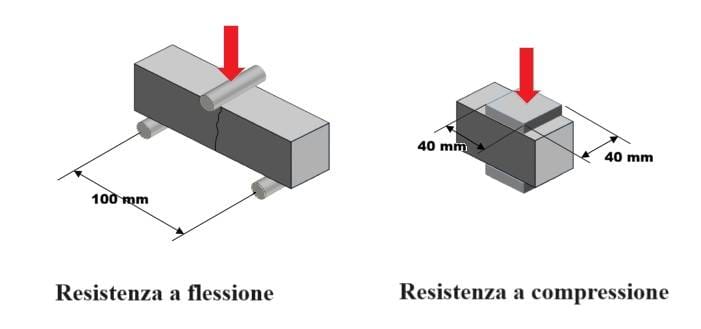
Flexural and compressive strength tests on materials: load application diagram and dimensions of the test surfaces (© Gianluca Ghirardini) (labels in Italian)
Compression testing of subfloors: why the screed method is not always suitable
Applying EN 13892-2 to a very lightweight subfloor can therefore create both practical and interpretative difficulties. The material may not withstand the prism preparation required by the method, may crumble locally under the platens, or may deform extensively without reaching a clearly recognisable failure. Even when the machine gives a value, that number may not represent the behaviour of the layer in service well.
The point is not to lower the EN 13813 classes arbitrarily. The first question is whether the product being tested is actually a screed material falling within that scope, or a subfloor material with a different function and mechanical response. A test designed to discriminate high performance loses sensitivity and meaning when it is transferred to very porous, cellular or compressible matrices.
Deformable subfloors: what the stress at 10% deformation indicates
For materials that do not fail at low loads and/or are not brittle, it is more useful to describe their behaviour through the stress-strain curve.
The principle adopted by EN 826 for thermal insulation products consists in compressing a specimen and measuring the stress associated with a defined relative deformation. If no load maximum occurs first, the reference is normally the stress at 10% deformation, denoted σ10.
The value is calculated by dividing the load reached at that deformation by the initial area of the specimen. If the material shows a maximum before 10%, the strength corresponding to that maximum is considered instead, in accordance with the rules of the method.
The result should not be called “compressive strength” indiscriminately. For materials that continue to deform without failing, σ10 is a conventional stress at a predetermined deformation. This terminological distinction avoids treating the failure of a rigid screed and the controlled crushing of a deformable subfloor as equivalent.
The test method described in EN 826 allows the specimen dimensions and the loading rate to be changed. This is essential in order to use more homogeneous specimens (often larger than the classic 40 × 40 × 160 mm) and, above all, to adjust the duration of the test so that the measuring instrument gives reliable values.
Many subfloors nevertheless show brittle behaviour: in that case there is no need to wait for 10% deformation to declare a failure value, but the test could not be carried out with the requirements set for screeds.
Compressive strength: why it is an indirect indicator of quality
A high compression value does not automatically mean a reliable floor system.
The actual service loads reaching the screed and the subfloor are practically always much lower than the strength measured on the small specimen, especially when the covering also spreads the load over a larger area.
Through its tyres, an articulated lorry exerts a pressure that can easily be estimated at less than 1 N/mm2. The value rises somewhat in particular cases, such as forklift trucks with small, hard wheels or racking.
So why do we require a screed with much higher performance? Because, in service, a floor system is subject to many stresses other than “simple” compression. For example, for a screed that is to receive a bonded covering, it is far more important for the substrate to have high cohesion to ensure perfect adhesion.
The compression test is therefore an indirect indicator of the quality of the matrix, of the correct proportioning of the components, of density, compaction and curing.
It is not correct to turn the compressive strength figure into a universal judgement, independent of thickness, support and intended use. For the same material value, a concentrated load can produce very different effects depending on the stiffness of the screed above, the continuity of the support, the thickness of the layers and any voids or non-homogeneous areas.
This is why the designer should check the relationship between action and resistance across the entire build-up. In deformable subfloors, the deformation allowed under permanent or repeated loading may also be decisive, not just the value reached in a rapid test. A material can bear the load without failing and, at the same time, deform enough to damage the screed or the covering above.
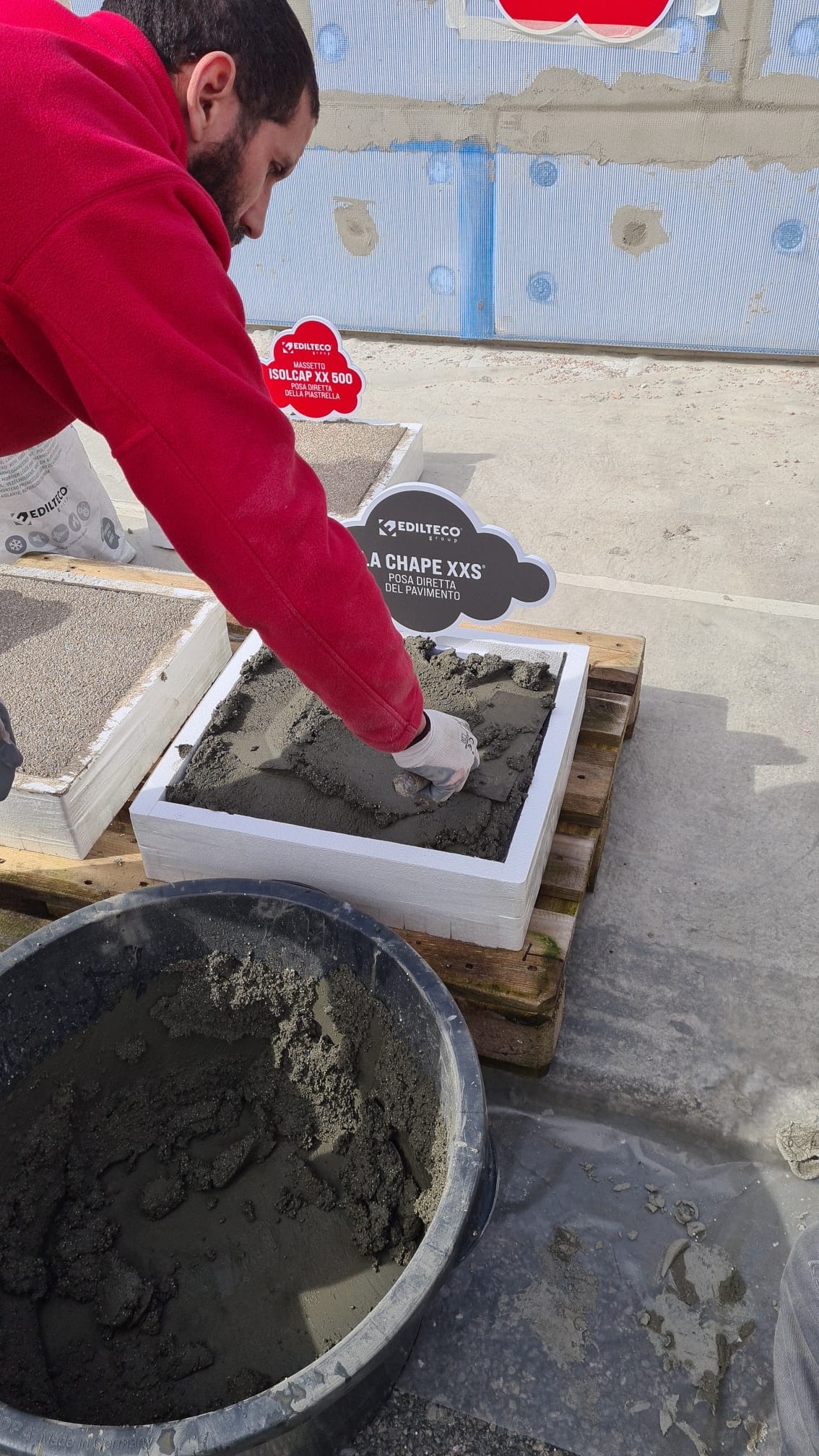
Preparing a screed sample
The laboratory and the site do not measure the same thing
In the laboratory, a material prepared according to a defined procedure is tested: controlled dosage, known water content, repeatable mixing, regular moulds, specified compaction and curing under controlled conditions. The figure describes the product under the conditions of the method and allows classification and comparison.
On site, on the other hand, the material actually laid is assessed, with all the variables of execution. The Italian standard UNI 11944 lists, among the causes of differences, mixing methods and times, mixing water, compaction, surface finishing and the temperature and humidity conditions during curing. For subfloors, there are also variations in density through the thickness, flotation or segregation of the lightweight aggregates, irregularities in the substrate, variable thicknesses and interference from services.
These variations depend essentially on two factors: the type and quality of the material on the one hand, and the way the installer carries out the work on the other.
Some materials are in fact easy to prepare and mix, which improves the repeatability of compression values on site. The human factor, however, always remains very significant.
There is therefore no direct, general correlation between the standardised value obtained in the laboratory and the value obtained from a sample taken on site. The latter can be very useful for diagnosing a non-conformity, but it must be accompanied by a sampling plan, a description of how the sample was taken, the actual geometry of the specimen and interpretation criteria defined before the test.
Sampling and coring of subfloors: limits of the compression test
Coring is an established technique for compact materials such as concrete, but it can be too aggressive for lightweight or poorly cohesive matrices. The rotation of the core bit, vibration, the action of water, extraction and subsequent grinding of the faces can introduce microcracks, detachment between paste and aggregate, crumbling and loss of material. The sample that reaches the press may therefore already be damaged.
The subtler risk is attributing to the subfloor a defect produced, at least in part, by the sampling method. The failure to obtain an intact core is also technical information, but it is not automatically equivalent to a quantitative measurement of in-place strength. Before concluding that the material is inadequate, it is necessary to document how the failure occurred: during cutting, during extraction, while preparing the faces or under load.
When sampling is indispensable, it is advisable to increase the number of samples, choose representative areas that are not already damaged, use low-vibration equipment and record diameter, slenderness, orientation, moisture and the method used to grind the faces. For very brittle matrices, it may be preferable to carefully remove larger blocks or portions, to be trimmed in the laboratory, or to supplement the figure with density measurements and indirect checks. None of these solutions, however, turns the site sample into an EN 13892-2 specimen.
Screeds and subfloors: how to set up a technically meaningful assessment
- First define the function of the layer: a screed intended to receive the floor covering, or a subfloor for filling, lightening or insulation.
- Identify the expected behaviour: brittle failure, progressive crushing, cellular collapse or viscoelastic deformation.
- Choose a consistent method: maximum load according to EN 13892-2 for screed materials; stress-strain curve and stress at 10% according to a relevant method, such as EN 826, for deformable materials.
- Link the requirement to the build-up and the loads: magnitude and contact area of the load, load-spreading capacity of the screed, thicknesses, restraints and intended use.
- Keep product control separate from diagnosis of the work: the standardised specimen describes the material; the site sample describes one point of the work and incorporates installation, curing and possible extraction damage.
Compression testing of screeds and subfloors: what to assess beyond the figure
The compression test is an important tool, but its value depends on asking the right technical question. For a rigid screed, EN 13892-2 and the EN 13813 classification provide an established language. For a lightweight or deformable subfloor, failure may not be the most representative parameter, and the stress at 10% deformation may better describe the response of the material.
It nevertheless remains essential not to confuse the property of the small specimen with the safety of the entire build-up. The subfloor works together with the substrate, the screed and the covering; it often bears actual stresses much lower than the laboratory value, but it can become critical because of deformation, lack of homogeneity or localised settlement. The test therefore serves to support a design assessment, not to replace it.
Standards of reference
EN 13813, Screeds and screed materials – Screed materials – Properties and requirements.
EN 13892-1, Methods of test for screed materials – Sampling, making and curing specimens for test.
EN 13892-2, Methods of test for screed materials – Determination of flexural and compressive strength.
EN 826, Thermal insulating products for building applications – Determination of compression behaviour.
UNI 11944:2024 (Italian standard), Screeds for floors – Design criteria, installation and verification methods.
UNI 11493-1:2025 (Italian standard), Ceramic tiling – Part 1: Instructions for design, installation and maintenance.
FAQ on compression testing of subfloors
Can EN 13892-2 be used for any subfloor? No. It is a method for screed materials and determines the maximum failure load on standardised specimens. For very lightweight or deformable subfloors, the criterion may be of little significance or technically difficult to apply.
What does the stress at 10% deformation indicate? It indicates the ratio between the load and the initial area of the specimen when the specimen has reached a relative deformation of 10%, if no maximum has occurred before. It is a conventional value, useful for materials that crush without a clear failure.
Does high strength guarantee that a subfloor is suitable? Not on its own. Thickness, homogeneity, deformability, continuous support, the load-spreading capacity of the screed and the loads expected for the intended use must also be checked.
Can the value measured on a core be compared with the one declared by the manufacturer? Not directly. The shape and size of the sample, installation, curing and damage caused by sampling differ from standardised laboratory conditions.
What should be done if the material breaks during coring? Document the stage and type of damage, avoid automatically turning the event into a strength value, and supplement the investigation with more samples, density, observations of the build-up and tests consistent with the matrix.
SHARE