Thank you for contacting us.
We will respond as soon as possible.

05 07 2026
RECYCLABLE ACOUSTIC INSULATION: EDILTECO TAKES IMPACT SOUND INSULATION INTO THE FUTURE
Edilteco develops fully recyclable impact sound insulation products, even in the versions coupled with polyester, with low dynamic stiffness: solutions that combine performance, durability and sustainability.
Camillo Signani – Sales Director, Edilteco S.p.A.
Impact sound insulation is evolving towards fully recyclable solutions, capable of ensuring high and long-lasting performance. The shift from traditional cross-linked PE materials to a new-generation polyethylene with elastomeric compounds makes it possible to improve dynamic stiffness, load resistance and stability. These solutions are part of a floor system approach, where the interaction between the different layers plays an essential role, and end-of-life recovery is becoming an increasingly important technical and environmental value for designers and contractors.
Impact sound insulation: why recyclability is now a technical requirement
The evolution of design criteria: from performance to life cycle
For many years, impact sound insulation was described almost exclusively through a single figure: noise reduction. A value expressed in decibels, a declared performance, a result to be achieved.
That figure remains essential, but today it is no longer enough.
The role of the floor system designer
Anyone designing a floor system knows very well that a resilient underlay must not only provide insulation. It must continue to do so over time, under load, within a real build-up, in contact with screeds, finishes and operating conditions that are often very different from one another.
Edilteco, which has been developing solutions for years to make the floor system more efficient and sustainable, works in this direction on several fronts: in acoustics, with fully recyclable resilient insulation products; in subfloors, with pre-mixed products that reduce free water and ensure controlled drying; and in thermal insulation, with materials containing a high percentage of recycled content.
In the field of acoustic insulation, this research translates into a clear objective: not to focus solely on initial performance, but to develop materials capable of providing high insulation, long-term stability and full recyclability.
In other words: high insulation, long-lasting insulation and complete recyclability.
Limits of traditional cross-linked PE underlays
Most of the underlays still used today are based on cross-linked PE.
These are materials that have performed well, but they have one clear limitation: they are not recyclable and, at the end of their life cycle, they become waste.
This aspect was overlooked for years, but today it can no longer be ignored.
The paradigm shift with Edilteco: fully recyclable acoustic insulation products
The market is undergoing an important transition. It is no longer just a matter of improving acoustic performance, but of designing materials that are fully recyclable.
This is where Edilteco’s work comes in: the company has developed a complete range of acoustic insulation products made with new-generation polyethylene combined with technical rubber compounds, fully recyclable even in the versions coupled with calibrated-density polyester.
This means that not only the main material, but all the layers of the product are designed to be recovered.
From theory to practice
The real difference becomes clear when the material reaches the end of its life cycle: when a material is truly recyclable, it can be collected and reintroduced into the production cycle.
Edilteco is also working in this direction: insulation products made with fully recyclable materials can be recovered, preventing them from becoming waste.
The same cannot be done with non-recyclable materials, such as many cross-linked PE underlays. This is where a technical choice also becomes a responsible choice.
Environmental footprint and acoustic insulation: choosing recyclable materials for impact sound insulation helps reduce the building’s environmental impact throughout its entire life cycle, without compromising performance and durability.
Performance and durability: being green is not enough
Of course, sustainability alone is not enough. An acoustic insulation product must perform, and it must continue to do so over time.
The most advanced solutions developed by Edilteco offer:
- very low dynamic stiffness, essential for impact sound insulation;
- greater dimensional stability;
- resistance to compression cycles;
- performance that is maintained over time, thanks to the technical rubber compound.
This means that the material does not only perform on the day it is installed, but continues to do so over the years.
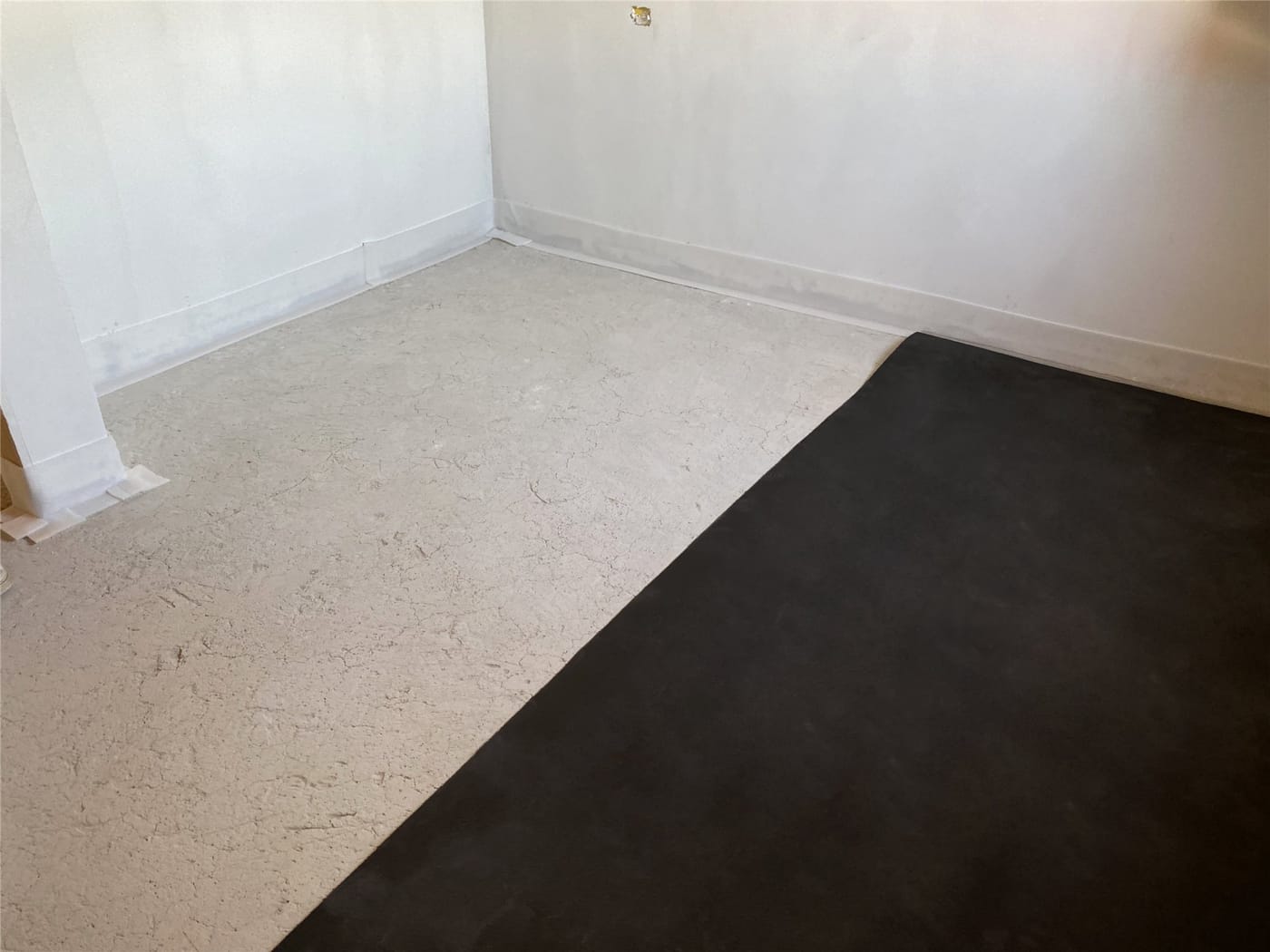
Installation of a dBred impact sound insulation underlay
The technician’s role: a choice that is now within reach
There is one point worth highlighting. For years, it was thought that choosing a more sustainable solution meant spending more or making the work more complicated. Today, this is no longer the case.
With Edilteco’s new acoustic solutions, it is possible to design systems that combine performance, durability and sustainability, without moving away from the practical requirements of the construction site.
How often have we wanted to do something for the environment without managing to? Today this is also possible in acoustics: not as a theoretical choice, but as a concrete technical one.
Standards and system: an unavoidable approach
In Italy, the Prime Ministerial Decree (D.P.C.M.) of 5 December 1997 sets the passive acoustic requirements of buildings.
The Italian standard UNI 11367 introduces the acoustic classification of building units.
The Italian standard UNI 11516 governs the installation of floating floor systems.
The Italian standard UNI 11944 introduces the concept of the floor system.
These references confirm that acoustic performance depends on the whole floor system and on correct installation, not on the single material: they all point in the same direction, where what matters is no longer the single product, but the system.
The dBred Fonotech range in the evolution of impact sound insulation materials
Within the evolution of solutions for impact sound insulation, the market today offers different technologies, with varying levels of performance, durability and sustainability.
In this context stands the dBred Fonotech range by Edilteco: a range of underlays in rolls, available in both coupled and uncoupled versions, designed for use in floating floor systems.
The products are made of polyethylene and can be coupled with needle-punched, resin-bonded polyester fibre, offering a good balance between elasticity, ease of installation and adaptability to the designed build-ups.
All these solutions are fully recyclable and designed according to circular economy principles, to combine acoustic performance, long-term stability and end-of-life management.
Main characteristics
- dBred Fonotech (3, 4, 5 and 10 mm): versatile solutions for acoustic insulation in different application contexts.
- dBred Fonotech Plus (7 and 14 mm): a separate product, available in two versions, for situations requiring higher acoustic performance.
- dBred Fonotech 5.6 Antiscratch (11 mm): variant designed to provide surface scratch resistance while maintaining good insulation performance.
A version with a reflective, tear-resistant, aluminium-coated overlapping film is also available, improving mechanical resistance and facilitating installation on site.
Application areas
The range is suitable for use on floor slabs with floating screed systems, contributing to the reduction of impact sound and the improvement of acoustic comfort, in line with performance requirements and installation conditions.
Looking to the future with a system-based approach
Edilteco is investing precisely in this direction: acoustic solutions that provide high levels of insulation, maintain their performance over time and can be recovered at the end of their life cycle.
This is the same approach that guides the company in the development of subfloors with less free water and of thermal insulation materials with recycled content: the future of construction does not depend on a single product, but on more coherent, more controlled and more sustainable systems.
It is an approach that the market, if it truly wants to be future-oriented, must begin to consider very carefully.
Conclusions: acoustic insulation between performance and sustainability
Acoustic insulation has always been linked to comfort. Today, it is something more: a choice that concerns the quality of the building, its durability and its environmental impact.
And perhaps, for the first time, those working with the floor system can truly contribute to sustainability without changing the way they work. Simply by making better choices.
Discover the dBred Fonotech range
Technical FAQs – Impact sound insulation and recyclable materials
What is meant by impact sound insulation? It is the ability of a floor system to reduce the transmission of impact noise between rooms one above the other.
Why is dynamic stiffness essential? Low dynamic stiffness values improve the attenuation of impact sound in floating systems.
What is the difference between cross-linked PE and recyclable polyethylene? Cross-linked PE cannot be remelted and recovered, whereas non-cross-linked polyethylene is recyclable.
Can acoustic insulation products be recycled at the end of their life cycle? Only if they are designed with compatible and separable materials, as in fully recyclable solutions.
How does installation affect acoustic performance? Incorrect installation can significantly compromise the performance of the floor system.
Do the materials maintain their performance over time? It depends on their resistance to compression cycles and on the stability of the material.
SHARE