Thank you for contacting us.
We will respond as soon as possible.

03 24 2026
PASSIVE FIRE PROTECTION OF FRP REINFORCEMENTS: REQUIREMENTS, CRITICAL ISSUES AND DEDICATED SOLUTIONS
FRP structural reinforcements provide lightweight solutions and high mechanical performance, but due to the presence of organic resins, they are vulnerable to high temperatures. For this reason, passive fire protection must be integrated from the design stage, using certified solutions that are compatible with strengthening systems.
Passive fire protection of FRP structural reinforcements is a key design issue for structural engineers and fire safety professionals. FRP systems offer lightness, high mechanical performance and fast installation, but the presence of organic resins makes them vulnerable to high temperatures. In the event of fire, thermal degradation can compromise adhesion and the structural contribution of the reinforcement.
For this reason, fire protection cannot be treated as a secondary check or a decision to be defined at a later stage of the project: it must be integrated from the very early design phases. Only in this way can the reinforcement maintain its effectiveness even under the most severe conditions, ensuring consistency between structural safety and the overall fire strategy.
Why FRP reinforcements are vulnerable to fire
The critical point is well known. FRP reinforcements owe their effectiveness to the presence of an organic resin that ensures adhesion to the substrate. It is an essential component, but also the one most vulnerable to high temperatures. In the event of fire, the resin’s thermal degradation can quickly compromise the reinforcement’s performance, calling its structural contribution into question precisely under the most severe conditions.
For designers, this means something very concrete: it is not enough for the reinforcement to work—it must continue to work even when conditions become extreme.
And this is where passive fire protection stops being a detail and becomes an integral part of the system.
What is passive fire protection for FRP reinforcements
Passive fire protection for FRP systems consists of applying certified solutions designed to limit the temperature rise of the resin matrix, preserving adhesion and the structural contribution of the reinforcement in the event of fire. It is part of the overall fire strategy and must be coordinated with the structural design.
Protherm Light® FRP: a dedicated system for the fire protection of FRP reinforcements
It is precisely from this need that Protherm Light® FRP was developed — Edilteco’s solution for the passive fire protection of structural reinforcements in FRP with organic resin. Not an adapted product, but a system conceived from the outset for this specific application field, with the aim of filling a real gap in the design of FRP strengthening systems.
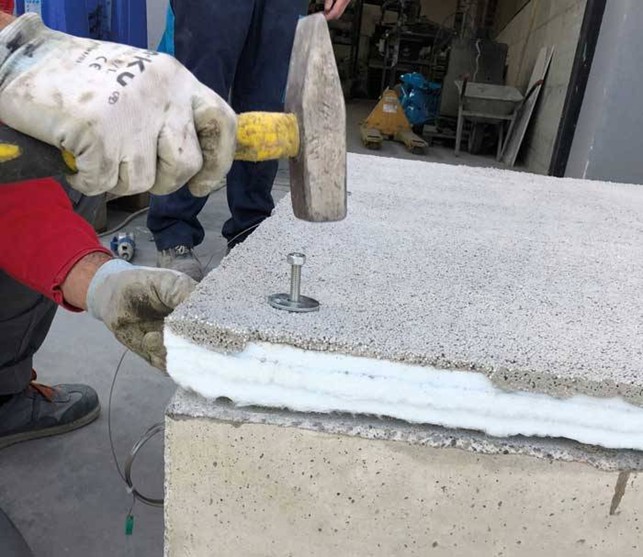
Mechanical fastening test of the passive fire protection panel on a concrete substrate: verification of the stability and anchorage of the system protecting the FRP reinforcement.
Composition and technical features
The logic is simple: to provide effective protection without undermining the principles that make FRP systems so attractive and efficient. Protherm Light® FRP comes as a bonded composite panel, consisting of a nanotechnology panel combined with Protherm Light® cement-based plaster, with a total thickness of just 40 mm. This thickness makes it possible to integrate the protection even in retrofit interventions, where every additional centimetre can become a design constraint.
Its low weight—around 11 kg/m²—follows the same logic: protect without adding unnecessary load, staying consistent with the structural approach typically associated with FRP systems.
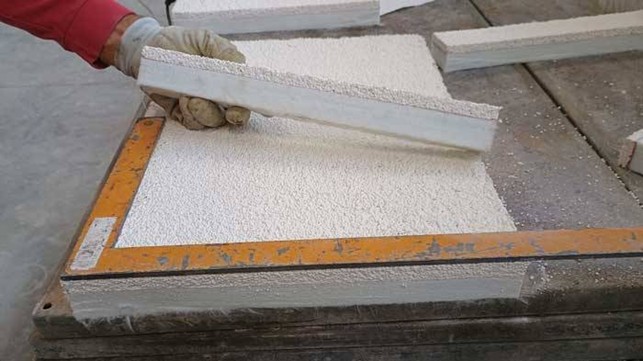
Section of the composite panel for fire protection of FRP systems: insulating layer and cement-based plaster integrated into a reduced thickness.
This need is particularly relevant in seismic upgrading or retrofitting works on existing buildings, where FRP reinforcements are often applied to beams, columns and the soffit of reinforced concrete slabs. In these cases, fire protection must ensure continuity even on articulated surfaces and complex structural joints.
Reaction-to-fire classes and EN 1363-1 testing
From a fire safety perspective, the system is based on components with high reaction-to-fire classifications (A2-s1,d0 for the panel and A1 for the plaster) and has been tested in recognized laboratories according to EN 1363-1. This is a key element enabling designers to correctly frame the solution within the overall fire prevention strategy, with clear and verifiable technical references.
Protherm Light® FRP was conceived to work with strengthening systems, not to overlap them. Application on substrates compliant with FRP technical assessments, together with the standardized installation procedures, makes it possible to achieve continuous and consistent protection even on beams, slabs and articulated soffits.
Edilteco tools supporting designers
To support the design process, Edilteco provides a dedicated installation manual and assistance from its technical department. In this way, passive fire protection for FRP reinforcements stops being an item to “sort out later” and becomes a conscious design choice, integrated from the very first phases of the intervention.
Coordination between structural design and fire strategy
The selection of the FRP system and that of the passive fire protection cannot be addressed independently. The structural designer and the fire safety professional must jointly define the required performance, installation methods and compatibility with the fire resistance verifications required by current regulations.
With Protherm Light® FRP, Edilteco provides a concrete response to a real critical issue: a dedicated solution, compatible with FRP systems, designed for professionals who need to make technical decisions today and want to do so with clear, reliable and consistent tools.
Technical FAQs on fire protection of FRP strengthening systems
Why is fire protection of FRP systems a critical design issue?
Because organic resins rapidly lose performance at high temperatures, compromising the effectiveness of the reinforcement in the event of fire.
Is Protherm Light® FRP a dedicated or an adapted solution?
It is a dedicated solution, specifically designed for the passive fire protection of FRP reinforcements.
What is the impact in terms of thickness and weight?
Total thickness of 40 mm and an approximate weight of 11 kg/m², suitable for retrofit applications.
Is the system supported by laboratory testing?
Yes, it has been tested in recognized laboratories in accordance with EN 1363-1.
Is it compatible with existing FRP systems?
Yes, it is designed to be applied on substrates compliant with the technical assessments of FRP reinforcements.
SHARE